
Thermo Fisher Scientific › Electron Microscopy › Electron Microscopes › 3D Visualization, Analysis and EM Software › Use Case Gallery
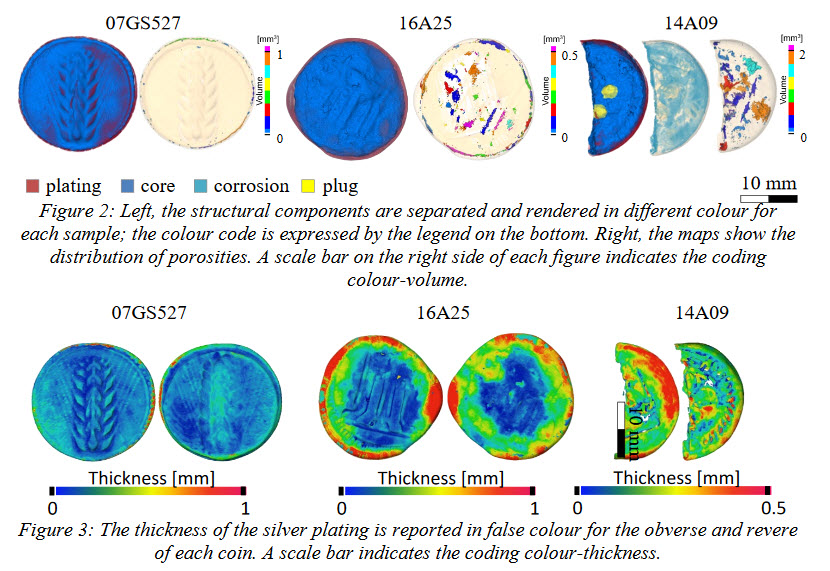
In the 6th century BC different techniques of coin manufacture were employed by mints in mainland Greece and in the Greek colonies in Southern Italy. In Greece these techniques were evidently derived from the Lydians and consisted in striking a piece of cast metal of predetermined weight (a ‘blank’ or flan) between two engraved dies made of hardened bronze. Colonies in Magna Graecia, however, uniquely developed another set of minting techniques to produce what today is called incuse coinage . One of the most distinctive feature of these incuse issues lies in the fact that the reverse type is the same as that on the obverse but is rendered as a ‘negative’ or ‘incuse’ image sunk into the flan. The study of this technique is part of a dedicated on-going project. It is evident that plated coins begin to appear at the very earliest stage in the history of coinage, and then become common place under the Romans. Plating, of course, involved an important modification of the mint’s usual production processes – as has been explored by La Niece. Were these plated coins issued by ancient state-authorities or the product of illegal counterfeiters? In an attempt to gain a better understanding of the technology of plated coins, numismatic and historical studies were combined together with metallurgical research based on neutron methods. This study focuses on a neutron tomographic analysis conducted on a set of plated silver coins minted in the city-state of Athens and in the Greek colonies of Kroton and Metapontum (South Italy or Magna Graecia) during the 6th and 5th centuries BC. The investigation aims to define the plating method by characterising the morphological and structural features of the specimens, i.e. the volume fraction of metallic and non-metallic components, and thickness maps of the plating and porosity. The status of these coins is uncertain: were they official issues authorized by state-authorities during periods of trouble (and silver shortages in the public treasury) or the product of ancient or modern counterfeiters?
Thermo Scientific Avizo Software was used for visualization and porosity analysis of the macrostructure to understand that in all cases the silver plating was applied by diffusion bounding to a copper core, but noticeable differences in the coating structure, and in the silver-copper ratio suggest different procedures, variations in effort required to complete the work, and finally variation in the expertise available to undertake plating.
For Research Use Only. Not for use in diagnostic procedures.