
Thermo Fisher Scientific › Electron Microscopy › Electron Microscopes › 3D Visualization, Analysis and EM Software › Use Case Gallery
Technological advances and energy demands have made tight sandstone reservoirs worth to be exploited. Tight reservoirs are characterized by low porosity and permeability and strong heterogeneity, especially considering the extensive development of nanometer-scale pore throats or the wide-ranging PSD. Previous studies reveal that the PSD and pore-throat structure have a more direct effect on the storage and transport performance of tight sandstone reservoirs than porosity and permeability. Different PSD and pore throat structures have different percolation mechanisms, which control the form, transportation, gathering, and recovery of tight gas and oil. Therefore, research on the pore structure characteristics in tight sandstone reservoirs is necessary.
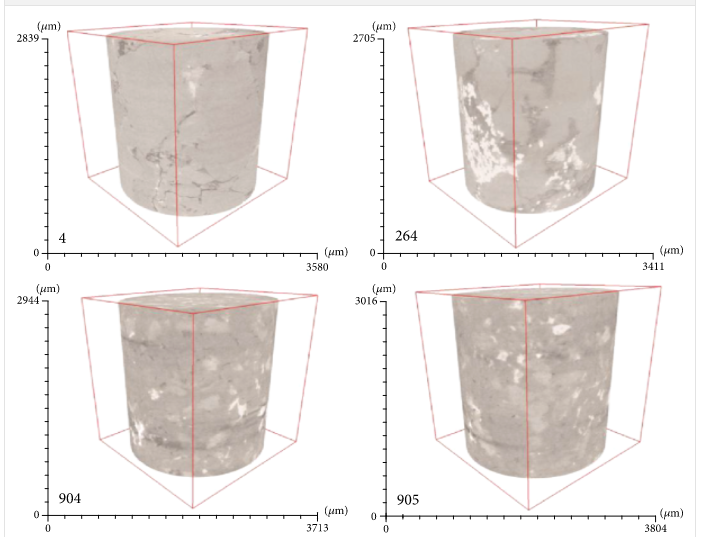
Two-dimensional XCT images were created using the software PerGeos 1.5. […] Stacking all the 2D XCT images, we can reconstruct a 3D visualization of the samples. Before pore space and mineral segmentation, the destriping filter algorithm is executed in order to remove the perpendicular curtaining irregularities arising during imaging. This algorithm increases the quality of subsequent porosity segmentation.
For Research Use Only. Not for use in diagnostic procedures.