
Thermo Fisher Scientific › Electron Microscopy › Electron Microscopes › 3D Visualization, Analysis and EM Software › Use Case Gallery
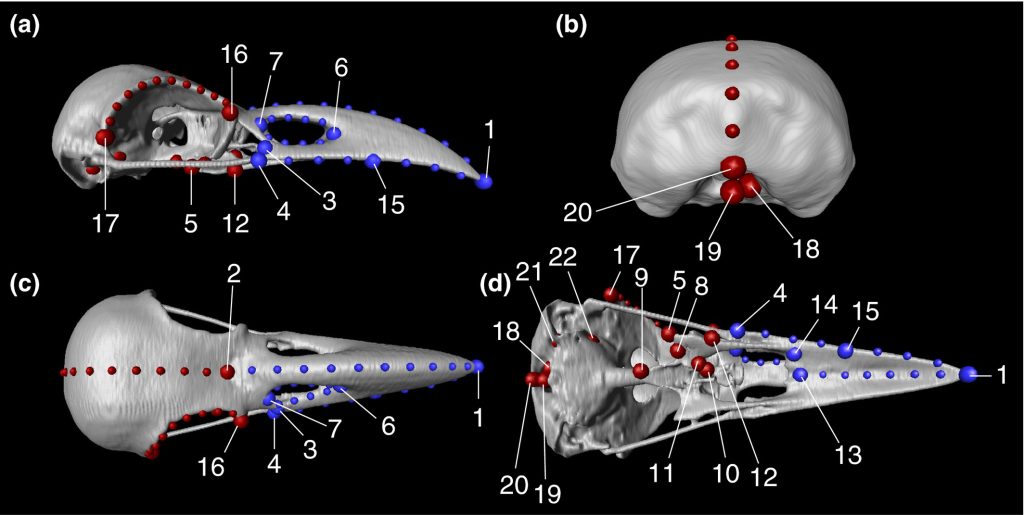
Here, to evaluate the intensity of evolutionary constraints on avian beak shape more appropriately, we selected large billed (Corvus macrorhynchos) and carrion crows (Corvus corone) as study objects. These landbird species seem to experience selection pressures favoring a departure from an allometric trajectory. A landmark based geometric morphometric approach using three dimensional reconstructions of CT scan images revealed that only 45.4% of the total shape variation was explained by allometry and beak–braincase integration. This suggests that when a selection pressure acts in a different direction to allometry and integration, avian beak shape can react to it and evolve flexibly. As traditionally considered, evolutionary constraints on avian beak shape might not be all that strong.
Amira 5.2.2 or 5.4.5 software was used to reconstruct 3D images from the scanned cross sections. We placed a total of 22 landmarks onto the right side of each 3D skull image using Amira. (…) The detected pattern of allometric transformation was then visualized using the prediction from the regression and the LandmarkSurfaceWarp module of Amira.
For Research Use Only. Not for use in diagnostic procedures.