
Thermo Fisher Scientific › Electron Microscopy › Electron Microscopes › 3D Visualization, Analysis and EM Software › Use Case Gallery
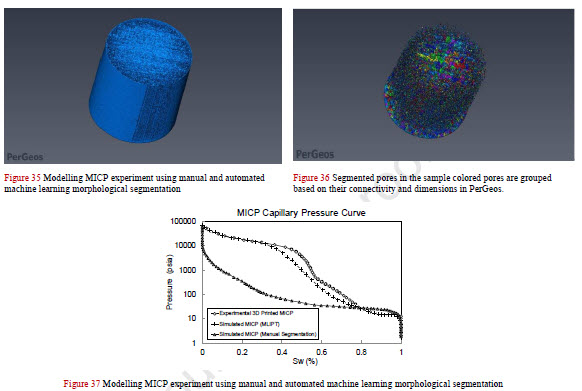
Laboratory Experiments on rock specimens are designed for understanding and characterizing subsurface environment, quantifying potential recovery, and tuning fluid flow models in porous media. The spatial variability and reservoirs’ heterogeneities predicate acquiring expensive cores from different locations. These experiments are mechanically and petrophysically destructive and cannot be repeated or extended on the same core. Replicating core samples with 3D-printing technology innovation alleviates the acquiring cost of rock samples and enables experiments repeatability and extension. This paper explains the workflow of creating accurate 3D printed core samples replicas using a machine learning image processing tool (MLIPT) based on natural cores’ CT scans. In addition to that, an extensive experimental investigation was conducted to check the veracity of the similarities between the natural samples and their 3D printed replicas. This comprehensive investigation showed that 3D printed rock-sample replicas are accurate, inexpensive, and adaptable specimens for laboratory research in the oil and gas sector.
PerGeos Software for digital rock analysis was used to implement the MICP experiment flow conditions on the segmented connected pores. Learn more about PerGeos Software
For Research Use Only. Not for use in diagnostic procedures.