
Thermo Fisher Scientific › Electron Microscopy › Electron Microscopes › 3D Visualization, Analysis and EM Software › Use Case Gallery
The prevailing electrode fabrication method for lithium-ion battery electrodes includes calendering at high pressures to densify the electrode and promote adhesion to the metal current collector.
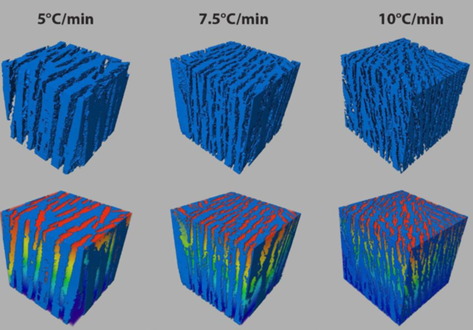
However, this process increases the tortuosity of the pore network in the primary transport direction and imposes severe tradeoffs between electrode thickness and rate capability. With the aim of understanding the impact of pore tortuosity on electrode kinetics, and enabling cell designs with thicker electrodes and improved cost and energy density, we use here freeze-casting, a shaping technique able to produce low-tortuosity structures using ice crystals as a pore-forming agent, to fabricate LiNi0.8Co0.15Al0.05O2 (NCA) cathodes with controlled, aligned porosity. Electrode tortuosity is characterized using two complementary methods, X-ray tomography combined with thermal diffusion simulations, and electrochemical transport measurements. The results allow comparison across a wide range of microstructures, and highlight the large impact of a relatively small numerical change in tortuosity on electrode kinetics. Under galvanostatic discharge, optimized microstructures show a three- to fourfold increase in area-specific capacity compared to typical Li-ion composite electrodes. Hybrid pulse power characterization (HPPC) demonstrates improved power capability, while dynamic stress tests (DST) shows that an area-specific area capacity corresponding to 91% of the NCA galvanostatic C/10 capacity could be reached.
Avizo software was used to visualize the 3D structure and to crop the data set to a cuboid volume of 500 × 500 × 500 voxels. Avizo XLab Thermo was used to calculate the effective thermal coefficient along the direction normal to the electrode plane.
For Research Use Only. Not for use in diagnostic procedures.