
Thermo Fisher Scientific › Electron Microscopy › Electron Microscopes › 3D Visualization, Analysis and EM Software › Use Case Gallery
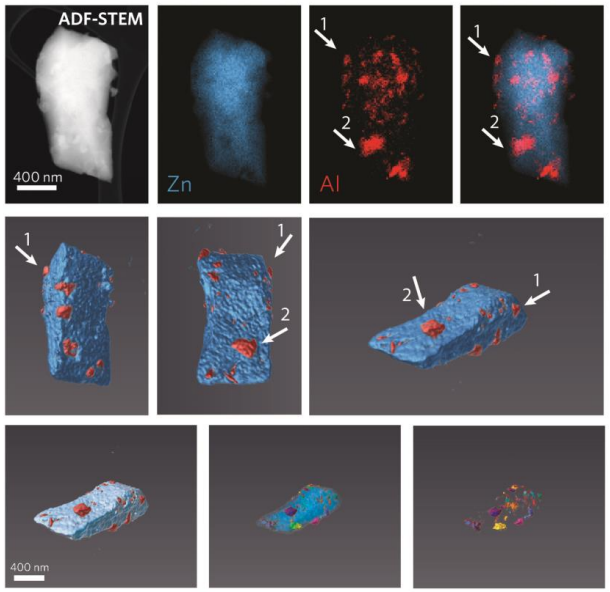
The majority of research into metal-organic frameworks (MOFs) focuses on their crystalline nature. However, in recent research the vitrification of a number of MOFs has been revealed. We propose that the solid-liquid phase transitions involved in MOF-glass formation can provide unique opportunities for the creation of a new class of functional, stable and porous composite materials. Described herein is the design, synthesis, and characterisation of novel metal-organic framework (MOF) crystal-glass composites, formed by dispersing crystalline MOFs within a MOF-glass matrix. We demonstrate using structural characterisation and analytical electron tomography, that the coordinative bonding and chemical structure of a MIL-53 crystalline phase are preserved within the ZIF-62 glass matrix. Whilst separated phases, the microdomains of each lie close to one another and possess interfacial interactions which improve the mechanical properties of the composite glass. More significantly, the high temperature open pore phase of MIL-53, which spontaneously transforms to a narrow pore upon cooling, is stabilized at room temperature in the crystal-glass composite. This leads to a significantly higher gas adsorption capacity for the crystal-glass composite than for either constituent phase.
Reconstructions were visualised in Avizo software without any further image processing. Visualisations are presented as volume renderings where each volume element is assigned a colour and relative solid appearance based on the intensity at the corresponding volume elements of the reconstruction. Visualisations for each independent element reconstruction were superimposed in the final visualisations and a selection of cuts through the volume were used to examine sub-surface features.
For Research Use Only. Not for use in diagnostic procedures.